

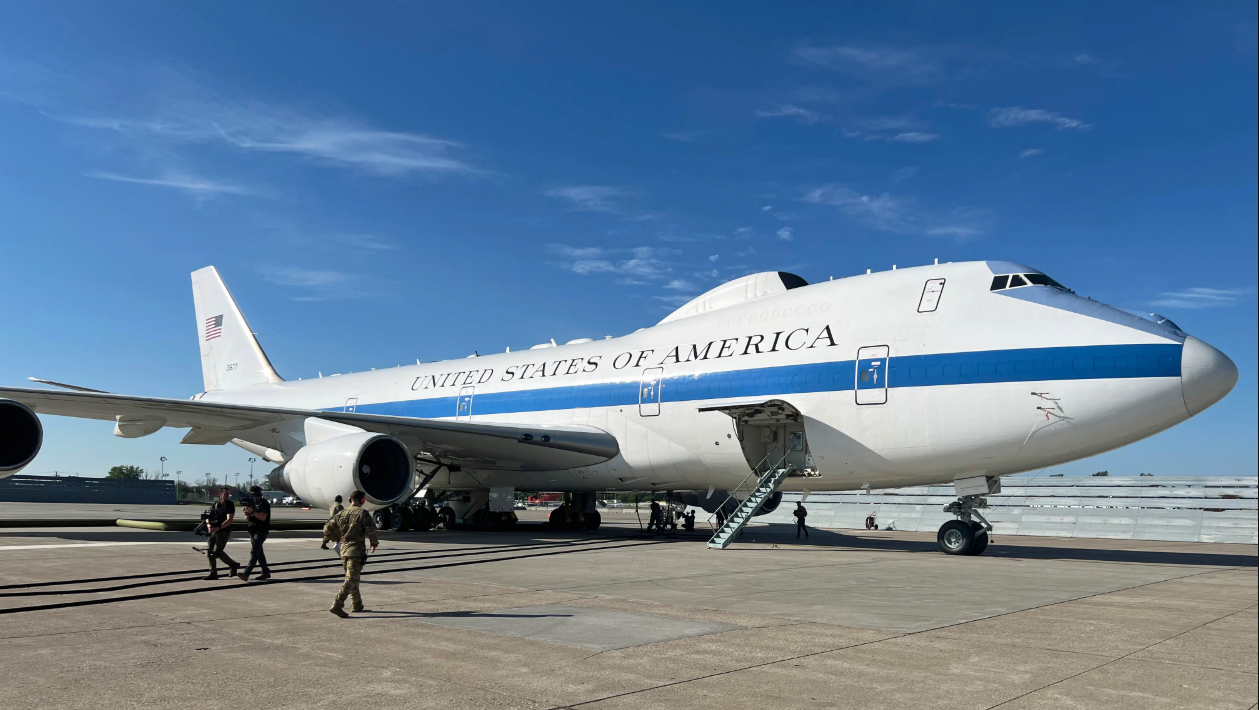
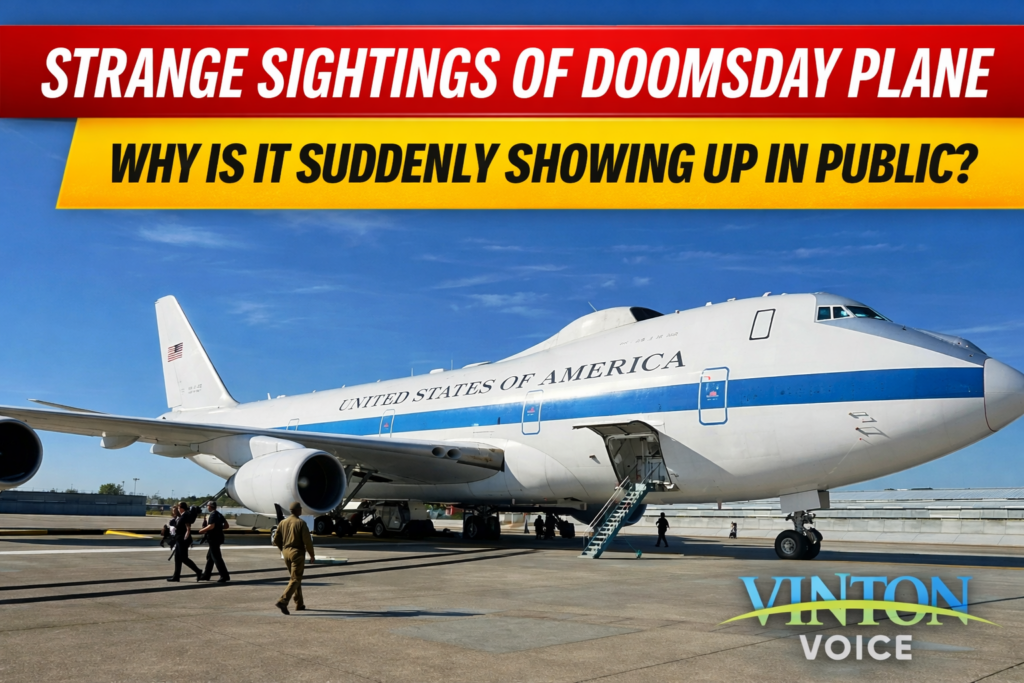
In a week already packed with headlines about global conflict, nuclear threats, and rising tensions overseas, an unexpected sight caught the public’s eye: the U.S. military’s E-4B Nightwatch, better known as the “Doomsday Plane,” was seen operating at or near major public airports, including Washington, D.C., and Los Angeles.
That alone is enough to raise eyebrows.
This is not a plane most people ever expect to see, especially not near civilian terminals.
A rare and unusual appearance
The E-4B Nightwatch isn’t just another military aircraft. It serves as the National Airborne Operations Center, a flying command post designed to keep the U.S. government functioning if ground-based command centers are knocked out during a major disaster or nuclear attack.
Only four of these aircraft exist. They’re normally based at Offutt Air Force Base in Nebraska and operate quietly, well out of public view. The planes are built to survive electromagnetic pulses, stay airborne for long periods with refueling, and communicate securely with military forces around the world.
Because of that mission, sightings near large civilian airports are extremely rare. Aviation watchers say landings at places like LAX are almost unheard of during the aircraft’s decades in service.
From a straightforward standpoint, there are reasonable explanations. These planes still need training flights. Crews have to stay sharp. Aircraft rotate for maintenance. Senior defense officials sometimes use secure aircraft for travel. The Pentagon has not suggested the flights are tied to any emergency.
Still, the timing has people talking.
Why the timing stands out
These sightings didn’t happen in isolation.
In recent months, news coverage has been filled with stories about:
- Nuclear warnings and rhetoric between major powers
- Growing conflicts in parts of the Middle East and Eastern Europe
- Military drills and readiness exercises worldwide
- Renewed public discussion around emergency planning, civil defense, and even the draft
Against that backdrop, seeing a plane designed for worst-case nuclear scenarios suddenly appear in public spaces feels, to many, like more than a coincidence.
Social media noticed almost immediately. So did alternative news outlets. Some reactions were measured. Others were anything but.
The conspiracy angle: coincidence or quiet messaging?
To skeptics and conspiracy-minded observers, the questions are simple:
If this plane is meant to stay out of sight, why is it being seen now?
If nothing serious is happening, why allow it to land where everyone can track it?
Some believe the flights could be:
- A subtle show of readiness meant to send a message without saying it out loud
- A precaution tied to intelligence the public doesn’t have access to
- A rehearsal for continuity-of-government plans in case tensions escalate
Others argue the visibility itself could be intentional — a way to signal that contingency planning is active, even if officials aren’t publicly acknowledging any increased risk.
History doesn’t help ease those concerns. Governments rarely announce emergency preparations before they believe they’re necessary.
The practical explanation
Defense analysts urge caution before jumping to conclusions.
The E-4B fleet still has everyday responsibilities:
- Keeping flight crews trained
- Moving aircraft through scheduled maintenance
- Transporting high-level officials securely
- Staying ready whether a crisis exists or not
In that light, the attention may be less about the plane itself and more about the modern environment. Flight-tracking apps, social media, and nonstop news cycles mean movements that once went unnoticed are now analyzed in real time.
What used to happen quietly now plays out in public view.
Why it still matters
Even if the explanation is routine, the symbolism of the Doomsday Plane is hard to ignore.
This aircraft exists for one purpose: continuity after catastrophe. Its presence is a reminder that nuclear war isn’t just a Cold War concept but something modern militaries still plan for.
Whether this was a training run, a logistical move, a message, or something else entirely, seeing the E-4B in public spaces taps into a broader unease — a sense that global stability doesn’t feel as solid as it once did.
And when officials say little, visibility fills the gap.
There’s no confirmation these flights signal an imminent crisis.
There’s also no denying that their timing, rarity, and meaning give people reason to ask questions.
Sometimes preparedness is just preparedness.
Other times, history shows, the warning signs only make sense after the fact.
For now, the Doomsday Plane has been seen — plainly and publicly — and the debate over what that means is still very much in the air.