

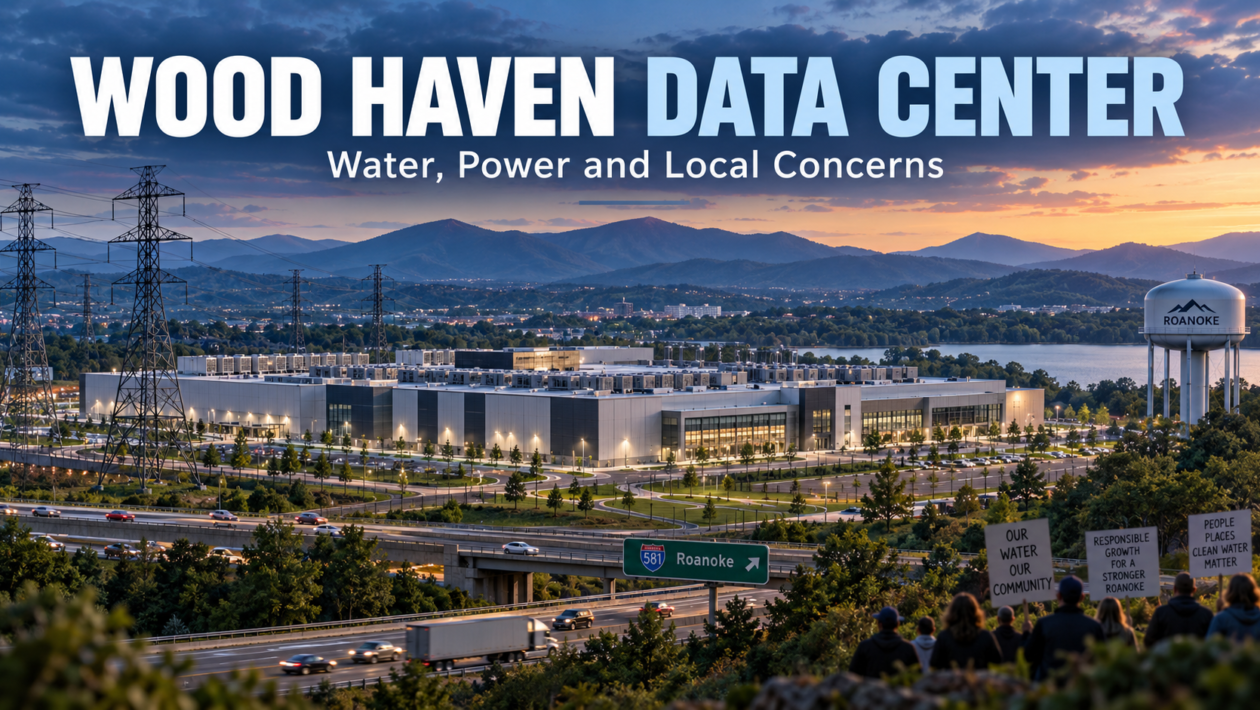
ROANOKE COUNTY, Va. — After weeks of speculation, closed-door meetings and growing public opposition, officials have now confirmed what many residents suspected: the Wood Haven Technology Park near the Interstate 81/581 interchange is being evaluated for development as a data center.
But confirming the intended use may actually raise more questions than it answers.
The Western Virginia Regional Industrial Facility Authority says Clearview Dynamics LLC is evaluating the approximately 111-acre Wood Haven Technology Park, which includes roughly 54 acres of graded, utility-ready land. The company remains in a due-diligence period expected to continue through March 2027, meaning engineering, environmental reviews and — importantly — studies of available electricity and water are still underway.
At this point, there is no publicly disclosed end user, no announced amount of electricity the facility would require, no published water-demand figure, and no publicly released performance agreement establishing how much investment or how many permanent jobs would be required.
And those missing numbers are important, because data centers can vary enormously in their impact.
THE BIG QUESTION: HOW MUCH WATER WOULD IT USE?
For Wood Haven, officials have identified Spring Hollow Reservoir as the likely water source. However, the Western Virginia Water Authority told reporters that it had not yet been contacted about the specific water requirements of the proposed development. That means there is currently no verified number showing how many gallons per day Wood Haven would actually consume.
That distinction matters.
Data centers do not all consume millions of gallons of water every day. Their usage depends heavily on the cooling technology, size and density of the computer equipment.
Virginia’s Joint Legislative Audit and Review Commission found that most individual data center buildings use about the same amount of water as, or less than, an average large office building. An average large office building in the study used approximately 6.7 million gallons annually.
But the extremes were dramatically higher. In 2023, JLARC found 11 Virginia data center buildings used more than 50 million gallons each, with one building consuming approximately 243 million gallons in a year.
Statewide, Virginia data centers consumed an estimated 2.1 billion gallons in 2023, though more than a third of that came from reclaimed water. Total data-center consumption represented less than one-half of one percent of statewide water withdrawals.
That statewide percentage can be somewhat misleading when discussing a specific community, however. Water supply is inherently local: a large user drawing from one particular reservoir during an extended dry period can matter much more locally than its percentage of all water consumed across Virginia.
And Roanoke is currently experiencing exactly the kind of conditions that make residents pay attention.
The Water Authority has had Stage 1 voluntary water conservation measures in effect because of dry conditions. Its two major reservoirs have been well below full pond this month. Spring Hollow holds approximately 3.2 billion gallons when full, while Carvins Cove holds approximately 6.42 billion gallons.
The original Wood Haven announcement reported Spring Hollow at 69.3% capacity and Carvins Cove at just 54.2% as of Tuesday.
That doesn’t mean Wood Haven would drain Spring Hollow. It does mean residents are asking for hard water-consumption numbers before another major industrial customer is added to the system.
AND THERE’S ALREADY ANOTHER HUGE DATA CENTER COMING
Just up Interstate 81, Google is developing a three-building data center campus at the Botetourt Center at Greenfield.
For planning purposes, the Western Virginia Water Authority has reserved up to 2 million gallons of water per day for Google’s Botetourt site, although county officials stress that reserved capacity is not the same thing as actual daily consumption. Google’s actual use could be considerably lower depending on cooling systems and operating conditions.
Google is also paying for infrastructure necessary to serve its development, and Botetourt County says each of the three planned data centers is expected to ultimately generate at least $10 million annually in incremental local tax revenue. Google has committed to at least 50 permanent positions per data center, in addition to substantial temporary construction employment.
Wood Haven currently has nothing comparable publicly available.
The authority says Clearview Dynamics would pay for the water and power infrastructure specifically required for the project, but the amount of water, amount of electricity, permanent employment and financial return to participating localities have not yet been disclosed.
WHY ARE PEOPLE PROTESTING?
Opposition around Wood Haven hasn’t just happened online.
Residents and data-center opponents packed the September 11 WVRIFA meeting when the authority approved the purchase agreement with Clearview Dynamics. Protesters later rallied outside Roanoke City Hall and spoke during the September 21 City Council meeting.
Groups such as the Southwest Virginia Data Center Transparency Alliance have also been filing public-records requests and pushing for greater disclosure surrounding data-center negotiations.
Their objections generally fall into several areas: water consumption during droughts, enormous electrical demand, potential increases in electricity infrastructure, noise from cooling equipment, backup generators and substations, development near residential neighborhoods, and the use of nondisclosure agreements and closed sessions before the public knows exactly what is being proposed.
Those concerns aren’t unique to Roanoke.
Data-center projects have faced organized opposition across Virginia. Residents in Goochland recently objected to a proposed 870-acre campus over water, electricity, noise, transmission infrastructure and rural land concerns. Projects in Prince William County have faced similar resistance, and Amazon withdrew a proposed Louisa County development in 2025 following intense local opposition.
Virginia’s own JLARC investigation concluded that poorly located data centers can create legitimate residential impacts, particularly from industrial-scale structures and persistent equipment noise. The study also found that data centers require far fewer permanent employees than their massive buildings and capital investment might suggest: a typical 250,000-square-foot facility may employ around 50 full-time workers, while construction can temporarily involve roughly 1,500 workers at peak.
ELECTRICITY MAY BE THE BIGGER ISSUE THAN WATER
Water tends to grab attention because millions of gallons are easy to visualize.
Electricity may ultimately be the larger statewide challenge.
JLARC found that Virginia’s electricity demand was essentially flat from 2006 through 2020 but is now projected to rise sharply, with data centers being the primary driver. Its independent modeling found that satisfying unrestricted future demand would require substantial new generation and transmission infrastructure.
The study estimated that a typical Dominion residential customer’s generation and transmission costs could eventually increase by roughly $14 to $37 per month by 2040, in constant dollars, under scenarios involving rapidly growing demand. That is a statewide modeling estimate — not a prediction of what the Wood Haven project itself would add to anyone’s bill.
Those concerns have now reached Richmond.
On September 18, Gov. Abigail Spanberger announced Virginia’s new Data Center Accountability Framework, directing state agencies toward greater disclosure, tighter environmental oversight, water-efficiency standards, noise rules and measures intended to prevent residential customers from absorbing infrastructure costs created specifically by massive electricity users. Some portions took effect through executive action while others will require legislation during the 2027 General Assembly session.
The timing is striking: the new statewide push for greater data-center transparency arrived just as the Wood Haven controversy was unfolding.
SO, WOULD WOOD HAVEN ACTUALLY BE BAD FOR ROANOKE?
There isn’t enough information yet to make that conclusion — and that may be the most important part of this story.
A data center isn’t automatically an environmental disaster.
If Wood Haven uses predominantly closed-loop or low-water cooling, pays for the infrastructure it requires, is properly buffered from surrounding homes, complies with strict noise limits and produces significant local tax revenue without transferring utility costs onto residents, the project could provide substantial economic benefits while keeping many of its impacts manageable.
Data centers are extraordinarily capital-intensive properties, and that can translate into a large tax base without bringing the traffic, school enrollment or daily population growth associated with a major residential development.
But there is another scenario.
A very large hyperscale or artificial-intelligence facility requiring significant water consumption and hundreds of megawatts of electricity could place considerably more pressure on regional infrastructure. Cooling equipment, substations, transmission lines and backup generators can also change the character of surrounding property, particularly when industrial development sits near established neighborhoods.
And while construction can create thousands of temporary jobs, Virginia’s own research shows that the number of permanent workers inside a completed data center can be relatively small compared with the enormous physical and utility footprint of the facility.
For Wood Haven, the information needed to tell those two scenarios apart simply doesn’t exist publicly yet.
We don’t know the megawatts.
We don’t know the gallons.
We don’t know the cooling system.
We don’t know the ultimate technology company behind the project, if there will be another end user.
We don’t know the permanent job commitment.
And we don’t yet know the guaranteed financial return to the Roanoke Valley.
Clearview Dynamics’ due-diligence period continues through March 2027, so some of those answers should emerge as engineering and utility studies progress.
The Wood Haven data center therefore isn’t proven to be bad for the Roanoke Valley — but neither is there enough public information yet to prove that the benefits outweigh its demands.
For a project potentially requiring extraordinary amounts of electricity and possibly significant amounts of water, the numbers that matter most are still blank.
And until those blanks are filled in, the real story at Wood Haven may be less about whether Roanoke should fear a data center and more about how much the public should know before one is built.