

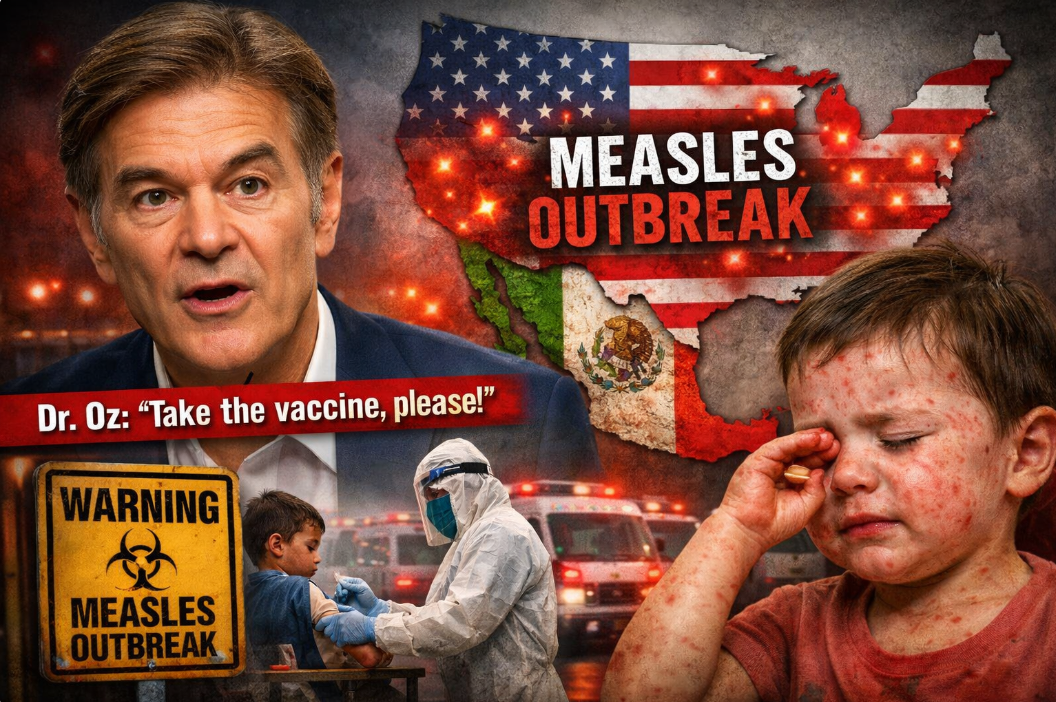
Measles — a disease many people assume was wiped out decades ago — is making a fast and troubling comeback, and health experts are warning that the window to stop it is narrowing.
This week, television physician Dr. Mehmet Oz issued a blunt message as confirmed measles cases continue to climb across the United States and spill over from a major outbreak in Mexico.
“Take the vaccine, please,” Oz urged, stressing that the current surge is not theoretical or exaggerated — it’s real, spreading quickly, and largely preventable.
A Sharp Rise in Cases
According to public health tracking, the U.S. has already recorded hundreds of measles cases in early 2026, far surpassing what the country usually sees in an entire year. Health officials say outbreaks have now been confirmed in more than 20 states, including parts of the Southeast, Northeast, Midwest, and West Coast.
States reporting notable activity include South Carolina, California, Florida, Virginia, Minnesota, Pennsylvania, Arizona, Georgia, Washington, and Maine, among others. In several cases, infections were linked to travel and then spread locally in under-vaccinated communities.
South Carolina, in particular, has drawn national attention after reporting one of the largest clusters seen in years.

Mexico’s Outbreak Adds Pressure
The situation is even more severe just across the southern border.
Mexico is dealing with a large nationwide measles outbreak, with thousands of confirmed and suspected cases reported across all 32 states. Public health officials there say the outbreak likely began with a single imported case before spreading rapidly.
Some regions have reintroduced emergency measures, including mask requirements in schools and temporary class suspensions, as hospitals work to manage the surge. International travel between the U.S. and Mexico has increased concerns about continued cross-border transmission.
Why Measles Spreads So Easily
Health experts say measles is one of the most contagious viruses known.
The virus spreads through the air when an infected person coughs, sneezes, or even breathes. What makes it especially dangerous is that measles particles can remain suspended in the air for up to two hours, meaning someone can be infected long after an ill person has left a room.
Doctors estimate that one person with measles can infect up to 18 unvaccinated people, making it far more contagious than many other viral illnesses.
Early symptoms often look mild at first — fever, cough, runny nose, and red, watery eyes — but the disease can quickly become serious. Complications can include pneumonia, brain swelling, permanent hearing loss, and death, especially in young children and people with weakened immune systems.
What’s Driving the Comeback
Public health officials point to declining vaccination rates as the primary reason measles has regained a foothold.
The measles, mumps, and rubella (MMR) vaccine has been used safely for decades and is highly effective. However, gaps in vaccination coverage — whether from missed childhood shots or misinformation — have created pockets where the virus can spread rapidly once introduced.
Dr. Oz emphasized that measles does not care about politics, personal beliefs, or geography. Once community immunity drops, outbreaks become inevitable.
What Health Officials Are Asking People to Do
Doctors and health departments are urging residents to take a few straightforward steps:
- Check vaccination records, especially for children and young adults
- Get the MMR vaccine if doses were missed or never received
- Seek medical care immediately for symptoms such as high fever and rash
- Avoid public places if exposed or feeling ill to limit spread
Officials stress that this outbreak is a warning sign — not just for major cities or border states, but for local communities everywhere.
Measles was once eliminated in the United States. The fact that it’s back in force is a reminder that prevention only works when it’s maintained. As Dr. Oz put it plainly, the tools are already available — but time is running out to use them.